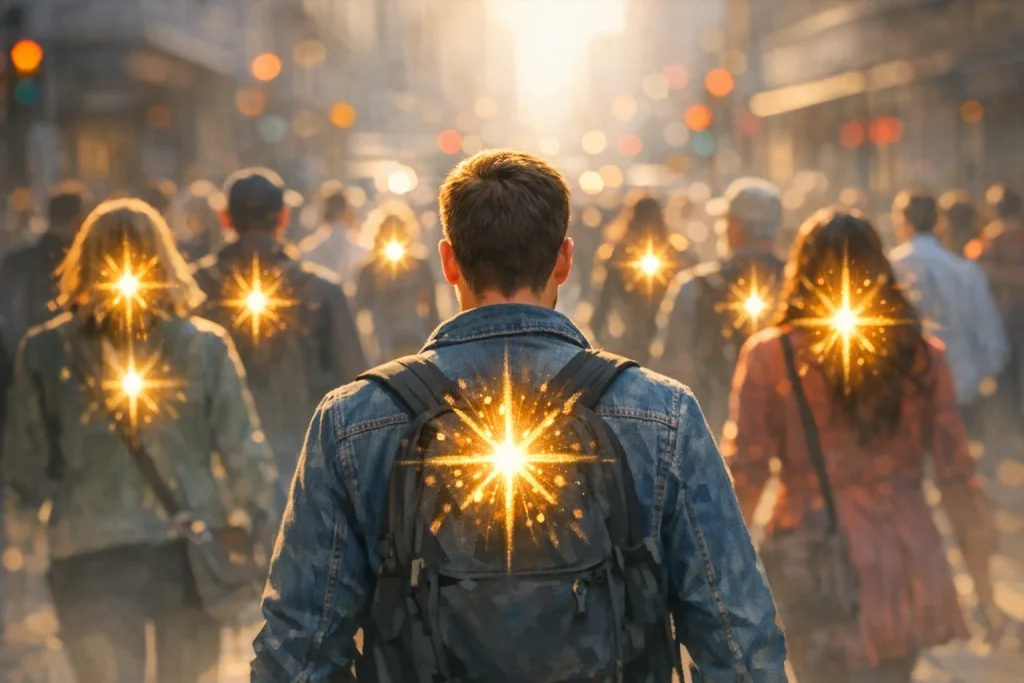
Learning to See the Spark of God in Everyone
Lately I’ve been reflecting on a simple but challenging spiritual idea: learning to see the spark of God in everyone.
For the past few years I’ve been drawn to the understanding that beneath all our differences there is a deeper unity—that life is not nearly as divided as it often appears. When we begin to see this, the world looks less like a collection of separate pieces and more like a living whole.
Yet this way of seeing can be difficult in a culture like ours that emphasizes individual success. We proudly repeat the phrase “out of many, one,” but often live as if it means something closer to “out of many, I should have more.” The sense that we belong to one another sometimes feels fragile.
The Quiet Work of Self-Compassion
One insight that keeps returning to me is this: To love others well, we must first learn self-compassion.
For many years I struggled with the feeling that I wasn’t enough—productive enough, effective enough, worthy enough. Self-compassion asks something very different of us. It asks us to see ourselves honestly and still say, “This is who I am, and I am still becoming.”
We all carry a shadow side. We all fall short of our ideals. Yet self-compassion reminds us that we are works in progress, unfinished but still worthy of love.
Holding Others in the Light of Their Possibility
Another lesson I’ve been sitting with is this: Accept people’s flaws, but hold them in the light of their potential for good.
Human beings are complicated. History shows us again and again how easily people can be influenced by fear, pressure, or circumstance. People who believe themselves to be good can still participate in harmful systems or unjust actions.
When I notice this in others, an uncomfortable but honest question arises: Would I always do better in their situation? The truth is, I’m not sure.
That realization doesn’t excuse wrongdoing, but it does soften judgment. None of us are defined solely by the best thing we’ve done or the worst. We live somewhere in between, shaped by our upbringing, our wounds, our culture, and the many unseen forces that influence our lives.
Choosing Love Even When We Don’t Fully Understand
Another thought has become important to me: My understanding of another person’s journey will always be limited—but I can choose love anyway.
Love doesn’t mean approving of everything someone does. Sometimes love even requires opposing injustice. But love also means remembering that every person carries both the seeds of destruction and the seeds of goodness within them.
To love is to act for the good of others, even when it isn’t easy, and even when we are unsure whether our love will be returned.
I’ve also been thinking about diversity—how easy it is to celebrate differences when they are comfortable, and how difficult it can be when those differences challenge our beliefs or values. Yet the richness of the world lies precisely in that diversity. If love is real, it must be wide enough to include even those who see the world very differently than we do.
Still, I hold onto hope.
I believe people can grow and change. I believe kindness often awakens kindness in return. And even when it doesn’t, love remains worthwhile.
The more I come to understand people, the easier it becomes to love them. And perhaps that is the deeper work of a lifetime—not simply believing in love as an idea, but learning how to live it.
Slowly, imperfectly, day by day.